
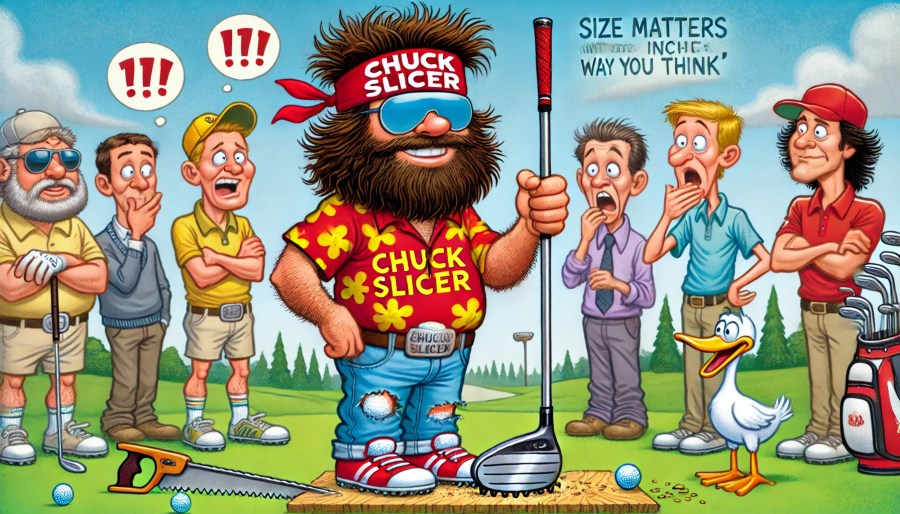
“Size Matters (But Not the Way You Think): Chuck Slicer’s Guide to Chopping Inches off Your Driver Shaft”

“Fellas, sometimes you gotta get shorter to go longer—just ask Tom Cruise on an apple‑box.”
— Chuck Slicer, 98‑octane golf philosopher

1. The Lengthy Lie We’ve All Been Sold

Somehow the stock driver you grabbed off the rack is 45.75‑46 inches long—nearly 1½ inches longer than what the pros use (Tour average ≈ 44.5″). MyGolfSpy
Why do we, the mere mortals, think we can swing a selfie‑stick and find the sweet spot more often than Rory? Spoiler: we can’t.


2. Chuck’s Totally Legit Science Experiment™

I hacked two identical big dogs:

ClubShaft LengthAverage Total DistanceFairway Accuracy
“Supersized”45.75″247.65 yd“Somewhere in the fescue”
“Diet Stick”43.75″247.15 yd (‑0.5 yd)+28 % fairways hit

Distance loss? Half a yard. Accuracy gain? Almost a third more fairways. Practical Golf · Practical-Golf.com
Translation: shorter shaft = center‑face contact + fewer walks of shame into the mulch.


3. Side‑Effects Observed in the Wild

  • Swing‑Speed Shrinkage: a whopping ‑1 mph (my backswing yawned).
  • Confidence Surge: like tightening your belt after Thanksgiving—everything suddenly feels controlled.
  • Trash‑Talk Bonus: telling your buddies, “Yeah, I’m shorter… AND straighter,” never gets old.

4. Chuck’s 3‑Step “Short‑N‑Sweet” Plan

  1. Trim Smart, Not Savage
    • Lop off 1 inch first; re‑swing. If your driver suddenly behaves, stop there.
  2. Add Weight or Grip Down
    • Cutting changes swing‑weight. A couple grams of lead tape behind the clubface keeps the feels silky.
  3. Test Like a Mad Scientist
    • Hit 10 balls each, track dispersion. If your shot pattern shrinks from shotgun blast to laser pointer—congrats, you’ve hacked golf.

5. But Chuck, Will I Lose Yardage?

Not if you hit the center. MyGolfSpy’s lab rats lost only 1.4 yards of carry on average after chopping two inches, and several testers actually gained distance thanks to better smash factor. Practical Golf · Practical-Golf.comMyGolfSpy
Half a yard is literally the difference between oops, divot and oh baby, stripe show.


6. Final Verdict

Shorter driver shafts are the dad‑bod of equipment changes: maybe not glamorous, but irresistibly effective. Give up an inch or two, gain a pile of fairways, and watch your buddies weep over their out‑of‑bounds reloads.

Swing easy, swing shorter, and remember—size only matters if you can control it.

Fore the Love of the Game: 7 Totally Serious Reasons the Masters Needs More Streakers*

*“Totally serious” in the way a double‑bogey is “totally planned.”

1. Golf Could Use a Little Cardio

Let’s be honest: outside of the occasional fist‑pump, the average PGA broadcast involves polite clapping and genteel murmurs of “good shot, sir.” A rogue streaker turns Augusta National into a spontaneous 100‑meter dash—security guards sprinting, commentators gasping, patrons ducking. Suddenly we’ve got Track & Field meets Amen Corner, and that’s content.


2. Instant Crowd‑Engagement Metric

Roars for a Tiger Woods birdie? Impressive.
Roars for a neon‑painted, barefoot sprinter dodging azaleas? Off the charts. TV execs dream of “viewer stickiness”—nothing keeps viewers glued like wondering whether the next shot will feature a 30‑foot putt … or 30 feet of airborne butt cheeks.


3. Free Marketing for Augusta’s Laundry Service

Green jackets are iconic, but grass‑stained security uniforms? That’s brand extension, baby. Every tackle becomes a commercial for “Augusta Dry Cleaners: If we can get mud out of khakis, we can get Magnolia Lane out of anything.”


4. Finally, a Break in the Tension on 12‑Green

The Masters is famous for Sunday pressure cookers. Golfers grinding over a six‑footer while a birthday‑suit blur streaks across Rae’s Creek? Instant stress relief! Nothing says “relax your putting stroke” like realizing you’re still the second‑weirdest thing happening on the hole.


5. Tradition? Let’s Add One More

We already revere pimento‑cheese sandwiches, ceremonial tee shots, and patrons who call the rough “the second cut.” Why not cement “The Annual Bare Cheeks Dash” as Augusta lore? Golf historians would have a field day:

“Yes, Jack won in ’86, but let’s not forget the fella in body paint who hurdled the Hogan Bridge…”


6. An Excuse for Jim Nantz to Break Character

Imagine the velvet‑voiced broadcaster forced to narrate:

“A tradition unlike any other—and there he goes, folks, a free‑range fan rocketing past the azaleas in what can only be described as… a full moon over Georgia.

We deserve this moment.


7. The Sport’s Greatest Test of Focus

Golf prides itself on mental toughness. If you can pure a 7‑iron while peripheral vision registers a blur of untanned epidermis, you, sir or madam, have earned that green jacket. Let’s separate the champions from the merely clothed.


Final Thoughts

Of course, Augusta’s rules committee probably disagrees with every single syllable above. But until someone starts a “Masters After Dark” exhibition, we’ll keep dreaming of the day a fearless fan adds a little aerodynamic flair to Butler Cabin lore.

So here’s to tradition, tranquility, and—just maybe—a tasteful dash of cheeky chaos. Golf purists may clutch their pearls, but the rest of us will be clutching popcorn and hitting “rewind.”

See you on the fairway—pants optional.

Reading the Green: An Art, A Science… or a Game of Guessing?

You’ve successfully navigated the tee box, the fairway, and the unforgiving rough (okay, maybe twice). You’re finally on the green—home free, right? Not so fast, champ. Before you can do your triumphant fist pump, there’s one more challenge: reading the putt.

1. The Squatting Golfer Stare

Ever notice how golfers transform into amateur contortionists on the green? One knee down, cheek smushed against the turf, eyes squinting like they’re deciphering an ancient treasure map. Yes, we all do the “Squatting Golfer Stare.” The unspoken hope: if you get just low enough, gravity itself will whisper the perfect line into your ear. Spoiler alert: it usually just whispers, “You’re going to leave this short.”

Pro Tip: No matter how many angles you check, the green is going to do what it wants. Accepting that is half the battle.

2. Consult the Caddy (aka Your Best Golf Buddy)

If you’ve got a buddy at hand, you might lean in for advice. “Does this look like it breaks left, right, or maybe it’s actually uphill?” Ten minutes of debate later, you’ve both come up with four different reads—none of which match your actual ball’s path. But hey, it’s the thought that counts.

Heads Up: If your pal has a track record of “birdies” that are really triple-bogeys in disguise, maybe take that read with a grain of salt.

3. Putt Reading by Feel… and Probably by Luck

The best putters will wax poetic about “feeling the slope underfoot” and “visualizing the cup as a vortex.” Meanwhile, the rest of us are just praying that the ball doesn’t become the unwitting star of the “lip-out” highlight reel. You know the one: it grazes the hole in slow-mo, does an almost-complete circle around the rim, and somehow decides not to drop.

Science vs. Sorcery: Some claim it’s physics, others believe the golf gods require a small sacrifice (likely a few extra strokes on your scorecard).

4. The Practice Swing That Never Fails… Until It Does

Take a practice swing. Perfect. Take a second one. Perfect. Step up to the ball. Perfect, right?

Sure, until your actual stroke sends the ball rolling in an entirely different direction—like a child wandering off at a theme park. It’s the ultimate golf paradox: the more perfect your practice swings, the greater your confusion when the ball “drifts” the moment you actually putt.

Conspiracy Theory: Is there a secret magnet in the cup repelling golf balls? Probably not…but you never know.

5. Accept the Unpredictability

At some point, you just have to line up, trust your instincts, and give it a roll. You might sink a beautiful putt that’ll be the talk of the 19th hole. Or you might leave it embarrassingly short—cue the humiliating “You need a sand wedge for that distance?” jokes from your group.

But that’s the fun of it. Golf without unpredictability would be, well, tennis. (No offense to tennis, but they have nets, and those things aren’t usually on a golf course—unless, of course, you’re having a real tough day.)


Conclusion

Reading the green is part science, part art, and all guesswork—wrapped in a pretty golf towel of optimism. Next time you’re crouched on the putting surface, trying to decipher your ball’s destiny, remember: sometimes it breaks left, sometimes it breaks right, and sometimes it just does whatever it wants. The key is to keep laughing, keep trying, and eventually sink that putt with as much style (and luck) as you can muster.

After all, in the grand scheme of golf, any putt that reaches the hole without rolling back to your feet is basically a victory, right?

How to Straighten Out Your Slice (Without Losing Your Marbles)

So, you’ve got a slice problem. On the bright side, you know how to hit the ball. On the not-so-bright side, your ball insists on visiting the neighboring fairway. Or the next county. Hey, you’re not alone—if slices were a club, we’d outnumber all the people with perfect drives by about ten million to one. Ready to tame that banana ball and maybe save a few golf balls from watery graves? Let’s do it!


1. Admit the Slice is Real

Step one is acceptance. Denial is no good—just ask all the people who keep aiming further left each time they slice, only to watch their ball still dive-bomb off to the right. (Yes, sometimes we start aiming so far left that the group behind us wonders if we’re trying to sneak into their fairway.) Instead, take a deep breath, let out a dramatic sigh, and proclaim, “My name is [Your Name], and I slice my drives.”

Therapy might help. But for now, we’ll stick to golf.


2. Check Your Grip (But Don’t Strangle It)

Ask yourself: “Am I trying to crush this club’s soul, or am I gently guiding it to glory?” A tight, tense grip is about as helpful to your shot as wearing high heels in a sand trap. Relax those forearms—tension often leads to a jerky swing, which can produce that dreaded left-to-right flight path.

  • Pro Tip: If your knuckles look as white as a golf ball, lighten up a bit!
  • Reality Check: If your club flies out of your hands mid-swing, well, lighten up a bit less.

3. Mind the Clubface (Not the Clubhouse Window)

When your clubface is open at impact, your ball sees that inviting patch of sky to the right and, well, heads straight for it. To fix that:

  1. Square It Up: Check that your clubface points toward the target at setup. (Standing behind the ball to line it up really helps.)
  2. Rotate Through: On your downswing, make sure you rotate your forearms. Think of it as shaking hands with the ball, rather than slapping its best friend from behind.

Bonus: Less shattered glass at the clubhouse = fewer awkward conversations.


4. Aim for That “In-to-Out” Swing Path

Your slice often crops up when your club travels from the outside in—like you’re chopping a log instead of sweeping through the ball. Picture your club moving along a slightly inside path:

  1. Practice with an Alignment Aid: Some folks put a pool noodle or training stick a few inches behind and outside the ball (without obstructing your actual swing path). If your swing is too “outside,” you’ll bonk that noodle.
  2. Low and Slow: Feel like you’re bringing the club back low along the ground for the first foot of your takeaway. This helps keep the club on an inside track.

5. Let Your Hips Do the Talkin’

In golf, your hips are the Beyonce of the show—they move first, they move strong, and everybody follows. If you’re locking your hips or swaying, you’re basically telling your shoulders, “Go do something weird on the downswing.”

  • Smooth Turn: Start your downswing by shifting weight from your back foot to your front foot, rotating your hips toward the target.
  • Keep Your Head Still-ish: Don’t bob up and down like a hyperactive meerkat. Stability up top, movement down low—that’s the recipe.

6. Enlist a Friend, a Mirror, or a Dog

Sometimes it’s hard to see what you’re doing wrong. Ask a friend to record a video on your phone. Or set up a mirror in your garage (and hope your spouse doesn’t mind you practicing indoors). Even your dog might bark in disapproval when you come over-the-top. Feedback is feedback, right?

  • Video Analysis: Watch in slow motion to see if your clubface is open at impact or if you’re swinging from the outside.
  • Mirror Drills: Focus on your stance, takeaway, and follow-through. Bonus if your reflection gives you a thumbs up.

7. Embrace the Range, Resist the Rage

Repeat after me: “The driving range is my laboratory.” (Insert mad scientist laugh here.) Work on drills specifically designed to fix slices. If you see progress, keep going. If you don’t, maybe hollering at the ball like a crazed person could help. (It won’t, but at least you’ll feel better—temporarily.)

  • Try a Foam Ball Drill: Practice half-swings with a foam ball, focusing on clean contact and squaring the face. Once you’re consistent, move up to real balls.
  • Set Micro-Goals: Instead of chasing the perfect draw right away, aim to reduce how far right your slice goes, little by little.

8. When in Doubt, Consult the Pros

If you’re at your wit’s end, consider booking a lesson with a local golf pro. (Preferably one who has a lot of patience and a sense of humor about four-letter words shouted into the sky.) A pro can spot mechanical issues in seconds that might take you months to figure out alone.

  • Tell Them Your Goal: “I want to banish this slice forever” or “I’d like my drives to land on this actual fairway.” They’ll guide you step by step.
  • Practice, Practice, Practice: Because, unfortunately, you can’t just let the pro swing for you. Life is unfair that way.

Conclusion: From Banana Ball to Straight(er) and Narrow

Fixing a slice isn’t exactly rocket science, but it can feel like brain surgery if you’re not patient. Remember: golf is a game of centimeters, not miles. One small tweak here or there can change your shot shape dramatically. So, keep at it—celebrate your incremental wins, laugh off the setbacks, and maybe treat yourself to a celebratory bogey juice (or beverage of your choice) next time you keep it in the fairway.

Here’s to your new, straighter drives—and hopefully fewer unfortunate golf balls meeting untimely ends in the woods!


Got your own slice horror stories (or near-death experiences involving tree ricochets)? Share them in the comments—we’re all in this perfectly imperfect golf journey together!