
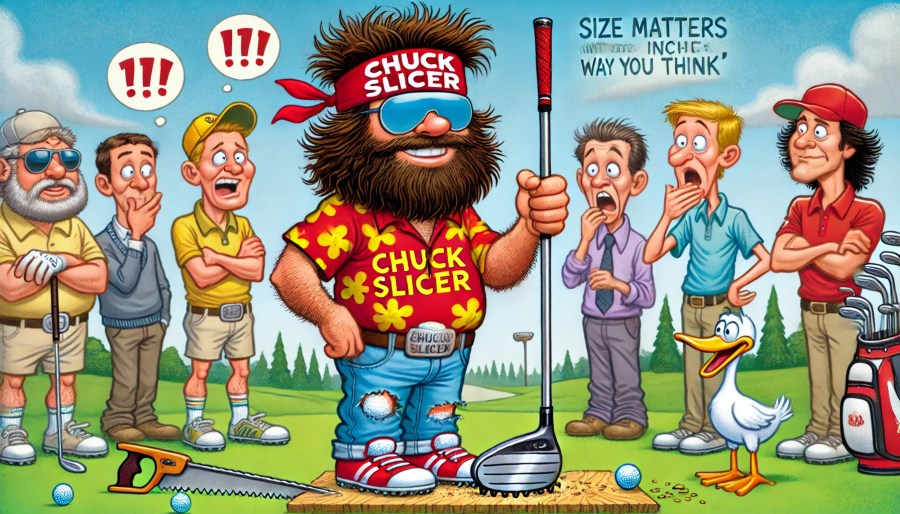
“Size Matters (But Not the Way You Think): Chuck Slicer’s Guide to Chopping Inches off Your Driver Shaft”

“Fellas, sometimes you gotta get shorter to go longer—just ask Tom Cruise on an apple‑box.”
— Chuck Slicer, 98‑octane golf philosopher

1. The Lengthy Lie We’ve All Been Sold

Somehow the stock driver you grabbed off the rack is 45.75‑46 inches long—nearly 1½ inches longer than what the pros use (Tour average ≈ 44.5″). MyGolfSpy
Why do we, the mere mortals, think we can swing a selfie‑stick and find the sweet spot more often than Rory? Spoiler: we can’t.


2. Chuck’s Totally Legit Science Experiment™

I hacked two identical big dogs:

ClubShaft LengthAverage Total DistanceFairway Accuracy
“Supersized”45.75″247.65 yd“Somewhere in the fescue”
“Diet Stick”43.75″247.15 yd (‑0.5 yd)+28 % fairways hit

Distance loss? Half a yard. Accuracy gain? Almost a third more fairways. Practical Golf · Practical-Golf.com
Translation: shorter shaft = center‑face contact + fewer walks of shame into the mulch.


3. Side‑Effects Observed in the Wild

  • Swing‑Speed Shrinkage: a whopping ‑1 mph (my backswing yawned).
  • Confidence Surge: like tightening your belt after Thanksgiving—everything suddenly feels controlled.
  • Trash‑Talk Bonus: telling your buddies, “Yeah, I’m shorter… AND straighter,” never gets old.

4. Chuck’s 3‑Step “Short‑N‑Sweet” Plan

  1. Trim Smart, Not Savage
    • Lop off 1 inch first; re‑swing. If your driver suddenly behaves, stop there.
  2. Add Weight or Grip Down
    • Cutting changes swing‑weight. A couple grams of lead tape behind the clubface keeps the feels silky.
  3. Test Like a Mad Scientist
    • Hit 10 balls each, track dispersion. If your shot pattern shrinks from shotgun blast to laser pointer—congrats, you’ve hacked golf.

5. But Chuck, Will I Lose Yardage?

Not if you hit the center. MyGolfSpy’s lab rats lost only 1.4 yards of carry on average after chopping two inches, and several testers actually gained distance thanks to better smash factor. Practical Golf · Practical-Golf.comMyGolfSpy
Half a yard is literally the difference between oops, divot and oh baby, stripe show.


6. Final Verdict

Shorter driver shafts are the dad‑bod of equipment changes: maybe not glamorous, but irresistibly effective. Give up an inch or two, gain a pile of fairways, and watch your buddies weep over their out‑of‑bounds reloads.

Swing easy, swing shorter, and remember—size only matters if you can control it.

Reading the Green: An Art, A Science… or a Game of Guessing?

You’ve successfully navigated the tee box, the fairway, and the unforgiving rough (okay, maybe twice). You’re finally on the green—home free, right? Not so fast, champ. Before you can do your triumphant fist pump, there’s one more challenge: reading the putt.

1. The Squatting Golfer Stare

Ever notice how golfers transform into amateur contortionists on the green? One knee down, cheek smushed against the turf, eyes squinting like they’re deciphering an ancient treasure map. Yes, we all do the “Squatting Golfer Stare.” The unspoken hope: if you get just low enough, gravity itself will whisper the perfect line into your ear. Spoiler alert: it usually just whispers, “You’re going to leave this short.”

Pro Tip: No matter how many angles you check, the green is going to do what it wants. Accepting that is half the battle.

2. Consult the Caddy (aka Your Best Golf Buddy)

If you’ve got a buddy at hand, you might lean in for advice. “Does this look like it breaks left, right, or maybe it’s actually uphill?” Ten minutes of debate later, you’ve both come up with four different reads—none of which match your actual ball’s path. But hey, it’s the thought that counts.

Heads Up: If your pal has a track record of “birdies” that are really triple-bogeys in disguise, maybe take that read with a grain of salt.

3. Putt Reading by Feel… and Probably by Luck

The best putters will wax poetic about “feeling the slope underfoot” and “visualizing the cup as a vortex.” Meanwhile, the rest of us are just praying that the ball doesn’t become the unwitting star of the “lip-out” highlight reel. You know the one: it grazes the hole in slow-mo, does an almost-complete circle around the rim, and somehow decides not to drop.

Science vs. Sorcery: Some claim it’s physics, others believe the golf gods require a small sacrifice (likely a few extra strokes on your scorecard).

4. The Practice Swing That Never Fails… Until It Does

Take a practice swing. Perfect. Take a second one. Perfect. Step up to the ball. Perfect, right?

Sure, until your actual stroke sends the ball rolling in an entirely different direction—like a child wandering off at a theme park. It’s the ultimate golf paradox: the more perfect your practice swings, the greater your confusion when the ball “drifts” the moment you actually putt.

Conspiracy Theory: Is there a secret magnet in the cup repelling golf balls? Probably not…but you never know.

5. Accept the Unpredictability

At some point, you just have to line up, trust your instincts, and give it a roll. You might sink a beautiful putt that’ll be the talk of the 19th hole. Or you might leave it embarrassingly short—cue the humiliating “You need a sand wedge for that distance?” jokes from your group.

But that’s the fun of it. Golf without unpredictability would be, well, tennis. (No offense to tennis, but they have nets, and those things aren’t usually on a golf course—unless, of course, you’re having a real tough day.)


Conclusion

Reading the green is part science, part art, and all guesswork—wrapped in a pretty golf towel of optimism. Next time you’re crouched on the putting surface, trying to decipher your ball’s destiny, remember: sometimes it breaks left, sometimes it breaks right, and sometimes it just does whatever it wants. The key is to keep laughing, keep trying, and eventually sink that putt with as much style (and luck) as you can muster.

After all, in the grand scheme of golf, any putt that reaches the hole without rolling back to your feet is basically a victory, right?